


.jpg?class=grid1)



.jpg)
NATURE, NURTURE, NARRATIVE: ALICE ZAWADZKI ON HER TRIO’S ALBUM ZA GÓRAMI
BY BEN NICHOLLS
FRIDAY 28 AUGUST 2026
Beyond the mountains, this trio is making something new from stories of old.
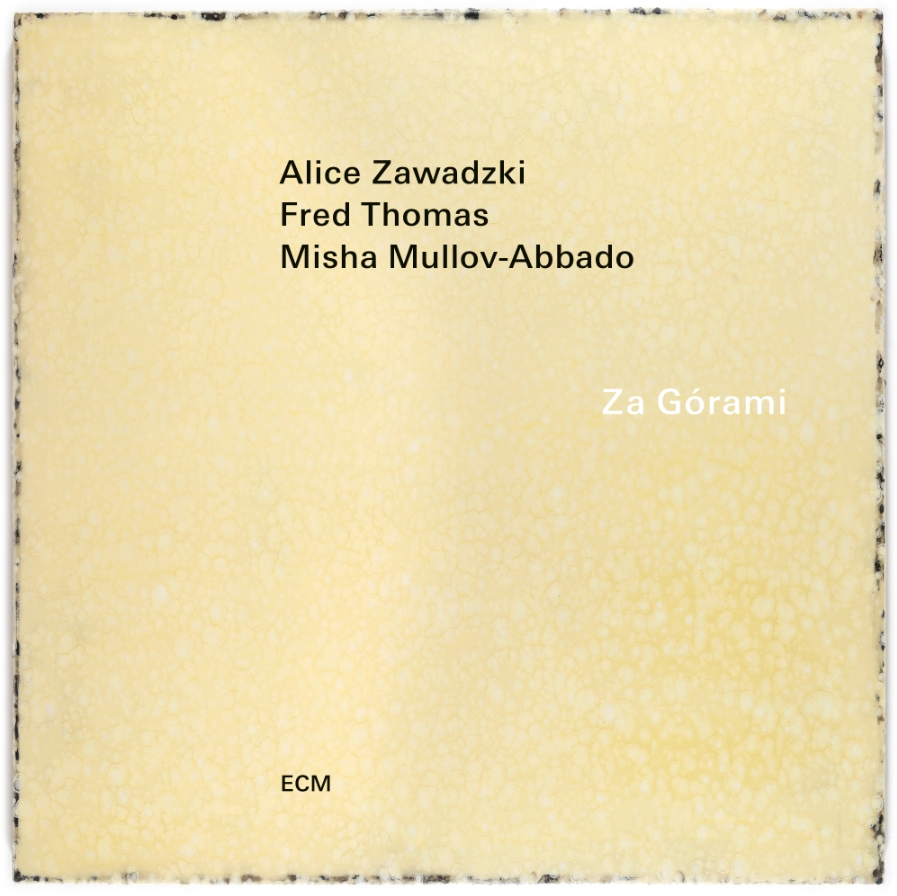
When singer Alice Zawadzki, pianist Fred Thomas and bassist Misha Mullov-Abbado walk on stage at UKARIA, the windows behind them will show Mount Barker Summit lit by the setting sun. It will be a fitting backdrop for the trio’s project Za Górami, meaning ‘behind the mountains.’ Their songs tell old stories, like the title track ‘Za Górami’ which is a Polish phrase equivalent to ‘once upon a time.’ Talking with Alice, it becomes clear that these stories live on in the present or, as she put it, the past sometimes comes ‘crashing into the future.’ To reimagine the album’s breathtaking selection of songs – passed on from family and friends across the world – this dream trio has pursued ‘a different type of virtuosity.’
Alice describes her bandmates as being ‘phenomenal in a lot of shared ways and then in quite a lot of more distinct ways as well’. She met double bassist Misha – son of famed Russian violinist Viktoria Mullova and Italian conductor Claudio Abbado – at a party. Putting him through his paces, Misha was able to play whatever Alice requested on a vibraphone that happened to be there. ‘I would just shout things out to him like Beethoven Violin Concerto, Sibelius Fifth Symphony,’ she recalls, ‘any sort of big classical piece of music and he would start to play it.’ This stupendous party trick is impressive, but it also shows the trio’s broad musical influences on their way to becoming jazzers in the London scene.
Fred’s father is also a very fine violinist and so his childhood was shaped by Bach, Beethoven, Mozart, and Mendelssohn, as well as Feldman, Webern, Stravinsky and Schnittke (all featuring on an album Fred recorded with his father in 2015). Alice met Fred when they were teaching at the same school, becoming friends after she chanced on one of his albums which she says ‘sort of blew my tiny little mind really.’ In Fred’s work Alice found an ‘amazing amalgamation of all of these different influences, but in a way that doesn’t sound like fusion.’ Most importantly, Alice discerned a kindred sense of phrasing and rubato, as with Misha, perhaps reflective of their violinist parents.
As a violinist herself, Alice sometimes wonders if they are all haunted by ‘the ghost of the violin.’ In the trio, she is ‘mostly singing, Misha’s mostly double bassing, and Fred is mostly playing piano, but the sort of bowed string feeling is always swirling around us.’ In Bag of Bones, a collaboration with the pioneering new music ensemble Manchester Collective, Alice gave this ghost a material form. ‘I built these violins made out of clay to look like bones,’ she explains, and for the character on stage they embodied her ancestors’ stories and trauma. When the bone-violins cannot play, there comes a reckoning with this inheritance. It is as though in a violin, or in a bag of bones, we might be carrying more than one lifetime.
.jpg?class=twocol)
The blessings of a rich cultural inheritance are front of mind for Alice as they can ‘give us meaning and belonging,’ but there are dangers here too. Those same traditions ‘can make us insular, they can kind of stop traumas being allowed to process and transcend into something new.’ In the BBC documentary Yiddish Glory, another of her recent projects, Alice helped revive a collection of songs banned during the Soviet era. The music had been protected for several decades by Ukrainian librarians in defiance of stringent censorship. As part of the documentary, Alice gave the re-premiere of these songs, and one melody written by women in Uzbekistan seemed particularly resonant when sung at the brick factory where they had worked. That song had not been heard there since the 1940s. It had become something new.
On the title track from the trio's album, ‘Za Górami’, a young woman refuses to come home despite her parents’ pleading. She stays beyond the mountains, beyond the rivers, to dance and drink with a band of hussars. Alice has added another verse to the song in which the woman ‘commandeers a bird to fly out into the sky and take a message to her family, which is to say she’s never coming home.’ But the song returns to the original folk lyrics and their chilling conclusion: she 'danced and danced until she became old, and when the cold winds of winter blow right through you, you may wish that you had listened to what your mother said.’
In the trio’s version, they explore the tension between the bass and the melody. Alice tells me that the bass part is ‘purposefully not meant to match the vocal line, it’s supposed to sort of goad the vocal line,’ and they have been exploring this role for the bass as a group. The melody ‘doesn’t sync up with it unless you want it to,’ Alice says, but when she’s singing and does lock in with the bass, ‘it can feel like a real sort of punch in the chest.’ I wonder if this is the mother cautioning her daughter in the story, or maybe the push and pull of history, but it’s certainly a powerful reminder of how music makes us feel more than the emotions of a story.
As an ensemble, the trio pursue this shared vision with sympathetic sensibilities. ‘You can’t shortcut that,’ Alice says, ‘you sort of feel the same way about that because of a whole long lifetime of all of your musical experiences and influences.
On Saturday October 10, they will be playing at dusk, just for us.

.jpg?class=small)
This story features SoundCite integration indicated by grey text highlights. If you tap or click those highlights you can hear Alice speaking and an excerpt from the album Za Górami
Sounds Cited:
Interview with Alice Zawadzki, Friday 14 August at 6.30pm (ACST) / 10.00am (BST).
Alice Zawadzki (voice), Fred Thomas (piano) and Misha Mullov-Abbado (bass), 'Za Górami' from their album of the same name, 2024.