

.jpg?class=grid1)




ROBIN TRITSCHLER'S HEINE SONGBOOK
BY TAHLIA LAMEY
FRIDAY 17 JULY 2026
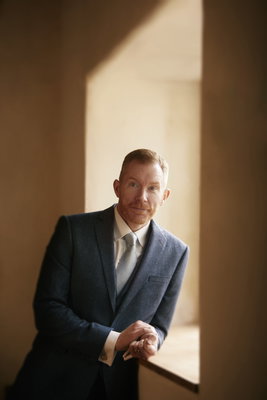
Ahead of his recital at UKARIA on Sunday 9 August, Tahlia Lamey interviews Irish tenor Robin Tritschler about his ‘Heine Songbook’.
Robin Tritschler’s program explores the lyric poetry of Heinrich Heine, a German Romantic poet who left an extraordinary imprint on nineteenth-century art song. Notably, Heine’s texts form the bedrock of song cycles such as Robert Schumann’s Dichterliebe (The Poet’s Love) and Franz Schubert’s Schwanengesang (Swan Song). With his thoughtful curation, Robin Tritschler pairs Dichterliebe with a diverse selection of songs that also draw upon Heine’s poetry.
The concept was born out of an invitation to take part in Wigmore Hall’s ‘Poet Series’ in 2018. Robin recalls that his original plan was to mirror Schumann’s Dichterliebe with different composers’ interpretations of the same Heine poems, however he soon changed tack. ‘I worked on it for a while but it just did not sit right, so I decided not to repeat any poetry. This threw up a different challenge; there may be a thousand vocal settings of Heine’s texts, but four hundred are of just one poem!’ Luckily, scouring second-hand bookshops and antiques fairs for song scores is a favourite pastime of Robin’s. ‘I buy scores which might sit on my shelf unsung for years, but at the right moment they come to mind.’ Out of this process of discovery, the final iteration of Robin’s ‘Heine Songbook’ brings to light nineteen miniatures by composers from Bruckner to Bridge, Liszt to Loewe, Mendelssohn to Meyerbeer.
This invites the question of what was so alluring about Heine’s work to these composers, many of them contemporaries of the poet. In Robin’s opinion, ‘I think Heine’s skill, and why, I presume, he is so attractive to composers (even in translation), is that the poem can usually be distilled into one overall idea. That is not to say that the poem is simple, but it is often composed of a succession of singular thoughts. The overall meaning of the poem is the sum of all those individual images or ideas, which quickly shift into each other during the recitation of the poem. For a composer who has one chance to affect their listener – and in song it can be a very swift chance – using a direct and immediate image or emotion is probably a very helpful practice.’
In this way, the composer is also offered a brief opportunity to share their own interpretation of the text, and I’m curious how they each add a unique layer of nuance to the works. ‘Heine’s poetry may appear simple,’ Robin replies, ‘but there is nearly always a deeper reason behind his writing, usually inspired by his personal views or experience. For instance, Komm, du schönes Fischermädchen, the first poem of my program, is not just a simple call from the shore for the innocent fisher-girl to row into his arms – rather, Heine is slightly mocking his own audience, enticing them closer to him for his pearls of poetic delight. But is Meyerbeer trying to say that in his musical setting? Composers decide how they wish to interpret the poem, and as performers, we need to find that interpretation and believe what we offer the audience is true.’
And so we arrive at Robert Schumann’s Dichterliebe. Composed in 1840, the year he married Clara Wieck, the song cycle explores the tragedy of the Lyrical Intermezzo from Heine’s Book of Songs, charting a poet’s self-destructive passion. There is an ongoing discussion among performers and musicologists about the angle of interpretation for this work, ranging from ironic – even sarcastic – to deeply emotional, and I ask for Robin’s take on the matter. ‘This cycle is the strangest choice for anyone to give to their new bride. Love turned to loss and bitterness,’ Robin comments. ‘But look beyond the text for a moment, and consider the deep, heartfelt sincerity of the love Schumann must have felt for Clara. Only someone who has experienced such profound love could imagine its loss. The pain, upset, turmoil, as well as the love and joy expressed in the cycle, are all real to Schumann, and every note of the music is forged with the strength of his emotion. An incredible wedding gift really.
If pressed, I would probably describe my reading of the piece as one of careful restraint. Love has already burst forth before the first song has even begun. From there, there is only a deflation towards rejection, some painful memories, and a dreamt happier reality. He does not just lose her love, but comes to reject the very idea of Love. The journey to such an acceptance is a long road.’
Since premiering this program at Wigmore Hall eight years ago, Robin has performed it in the Vocal Series at Konserthuset Stockholm, and the upcoming concert at UKARIA marks its third outing. On this occasion, Robin is collaborating with pianist Andrea Katz. ‘I first met Andrea when she was the repetiteur on an opera project at Britten Pears in Aldeburgh. We later worked together again on a Strauss opera in Hong Kong, and since then we have kept in touch. Her love of song, which has seen her create her own stable of singers for specific projects in Australia, is something which bonded us. But her selflessness towards any music is what impressed me most. I am really looking forward to working with Andrea again, and delighted to be able to introduce her to UKARIA.’