




MORGAN HICKINBOTHAM
MONDAY 1–WEDNESDAY 10 MAY 2023
Australian composer, producer and image-maker Morgan Hickinbotham was in residence at UKARIA from Monday 1–Wednesday 10 May 2023, as the latest recipient of our residency program facilitated by the Australia Council for the Arts in partnership with UKARIA. Our Communications Manager, Dylan Henderson, spoke with Morgan on the last day of his residency.
Thanks so much, Morgan, for taking the time to chat with us. For our audience who may not be familiar with you and your work, could you tell us a little bit about yourself, and your work to date?
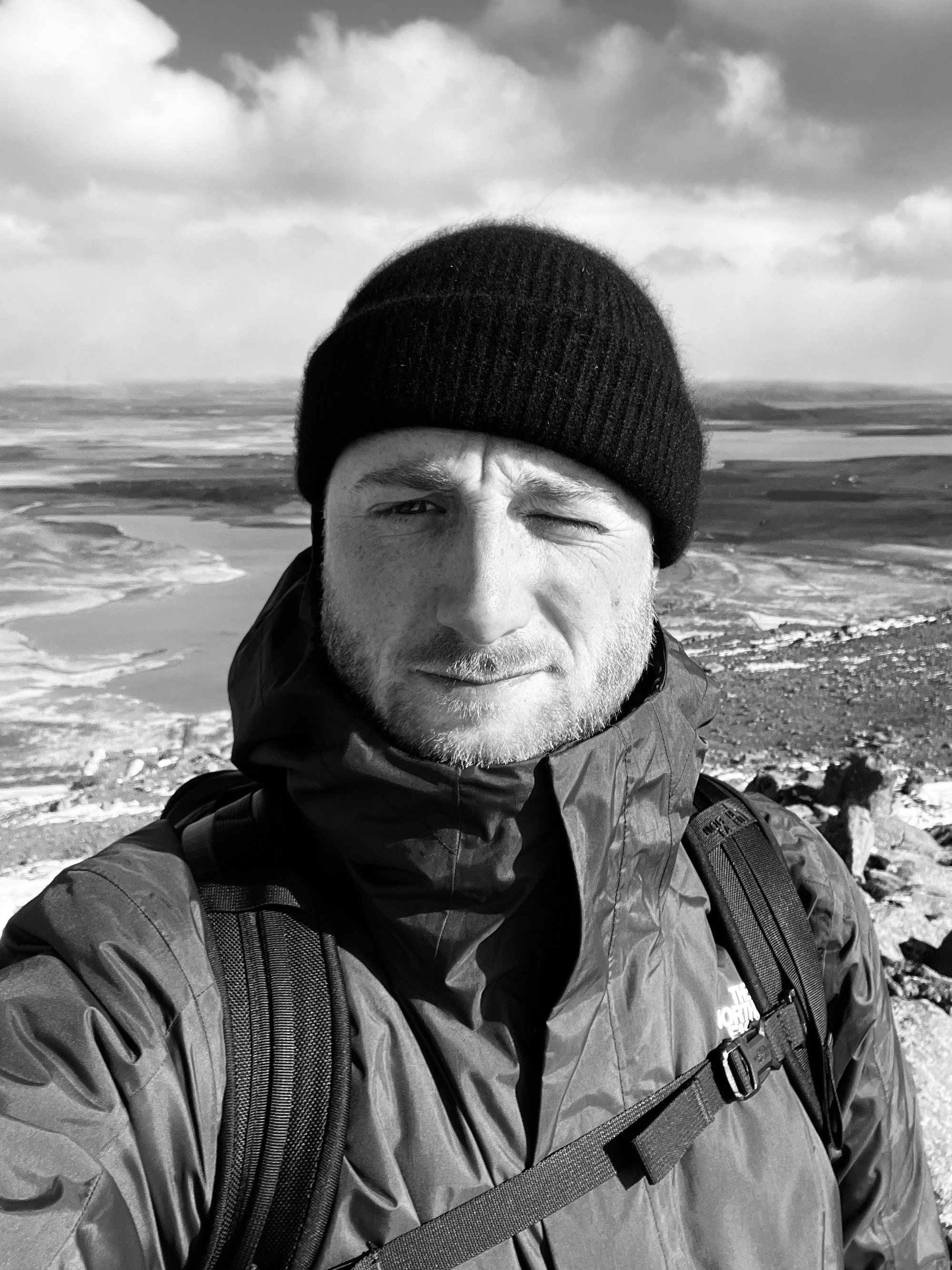
Sure. I’m an experimental sound artist, and I’ve been working as a composer for contemporary dance for the last ten years. Through that practice I've developed a synergy between movement and music, and that has really informed my personal practice, which is largely based around translating something from one state to another.
Back in 2018 I co-founded a site-specific sound studio called LAAP, and the purpose of that studio was to create compositional projects that embodied this process of translation. One of our first projects was called Reflections, and the process around that was transcribing dreamt music into physical music: over a period of eighteen months, I documented music that I had dreamt. Upon awakening, I had these little fragments of sound which I quickly documented. Over time, the memories became clearer, so we built a composition around this practice – of taking something from a state in which it didn’t really exist, to a physical state, where we transcribed that music and performed it on two cellos, with two cellists.
One of the other projects we did was called Compositions for the Pool. We started off this process by making field recordings of a pool in Phraran, Melbourne, where I had spent a lot of time from a child to an adult. The idea was to create a piece of music that could embody those memories and could also stand as a composition for the actual space, made by the space. In short, this process involved gathering field recordings, manipulating the field recordings to find natural harmonic occurrences; extrapolating on those, transcribing them into notation, and then collaborating with the Stonnington Symphony, who performed and recorded the work. Compositions for the Pool was put onto waterproof headphones, and an installation happened at the pool where swimmers could swim and listen to the composition made by the pool, while in the pool. There were lots of processes involved, translating it from one state to another.
Your new work was inspired by a visit to a glacier in Iceland. Talk us through that experience: how did you come to find yourself working with scientists from the Icelandic Glaciological Society, and how have these experiences informed and inspired your subsequent work?
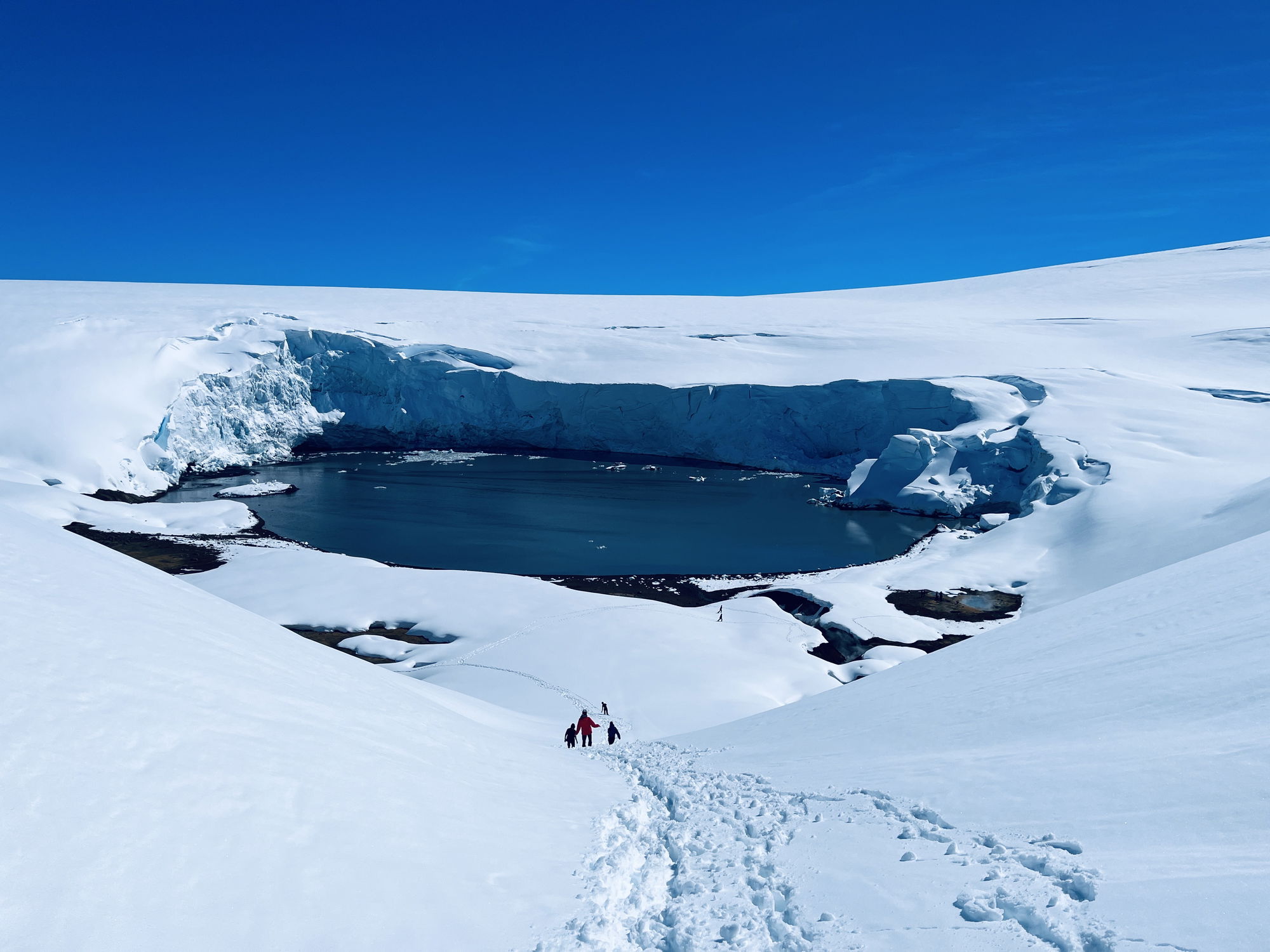
I was reading a book by the Icelandic author Andri Snær Magnason, called On Time and Water. In this book, he describes our relationship to long periods of time – to things happening across a very long period, which we can’t quite comprehend in the way that we experience time, and this specifically relates to climate change. In the book he also talks about early trips across the Vatnajökull glacier with the Icelandic Glaciological Society (IGS), of which Magnason's grandparents were some of the founding members in the 1950s. So having read this, I was really inspired to create a work that played around with the boundaries of time and space. I reached out to the IGS, and they invited me on their annual spring expedition across the glacier, and in May 2022, I joined them. The Vatnajökull glacier is the second largest glacier in Europe, and it’s about ten per cent of the land mass of Iceland.
So how long did you get to spend on the glacier?
Seven days. They have a camp – a series of huts that they’ve built in
the 1950s, which have been continually modified and upgraded. These
cabins are on the top of an area called Grímsfjall (or Grímsvötn), and
it’s essentially on a mountain ridge in the middle of the glacier that’s
overlooking a very large volcano, which is underneath the glacier – so
it’s quite a volatile area!
Were you making field recordings there?
Yeah, so the process was that we would set out for a specific task each day, and I would tag along with the scientists on whatever they needed to do. Stopping at specific points all across the glacier, I was able to collect field recordings, and gather sounds from melt-water lakes on top of the glaciers using a hydrophone. I was able to put seismophones down holes that they were digging to retrieve GPS locators, making recordings that are of a more seismological nature. And I was also there to gather field recordings of our physical journey across the glacier – recordings of the machinery that we used, and the way that we communicated with each other via radio.
Did you go there knowing that you already wanted to write a work in response to the glacier, or did you have the inspiration to write a work while you were there?
I went there with the intention of creating a work around the themes
of a glacial environment – specifically the cycling of water. At certain
points in a glacier where the ice is up to a kilometre thick, it can
take up to a thousand years for the water to go through the full cycle, from
falling on the top of the glacier to coming out of the glacial tongue.
Another theme is the memory that’s held by the glacier. There was one
location that we visited where you could see black lines running through
an ice wall, and those black lines were previous volcanic eruptions.
You had a clear visual calendar of all previous volcanic eruptions in the area dating back fifteen to twenty years.
How have you managed to translate that to Relativity, the new work you’ve been developing in residence at UKARIA?
I took the field recordings that I gathered at various locations on the glacier home to my studio and, using a similar process of translation that I’d used on some of my other projects, stretched the material out, found unique sonic occurrences within them, and built layers of sound and then mixed it together, recording it onto quarter-inch tape to create more of an ambient, experimental composition.
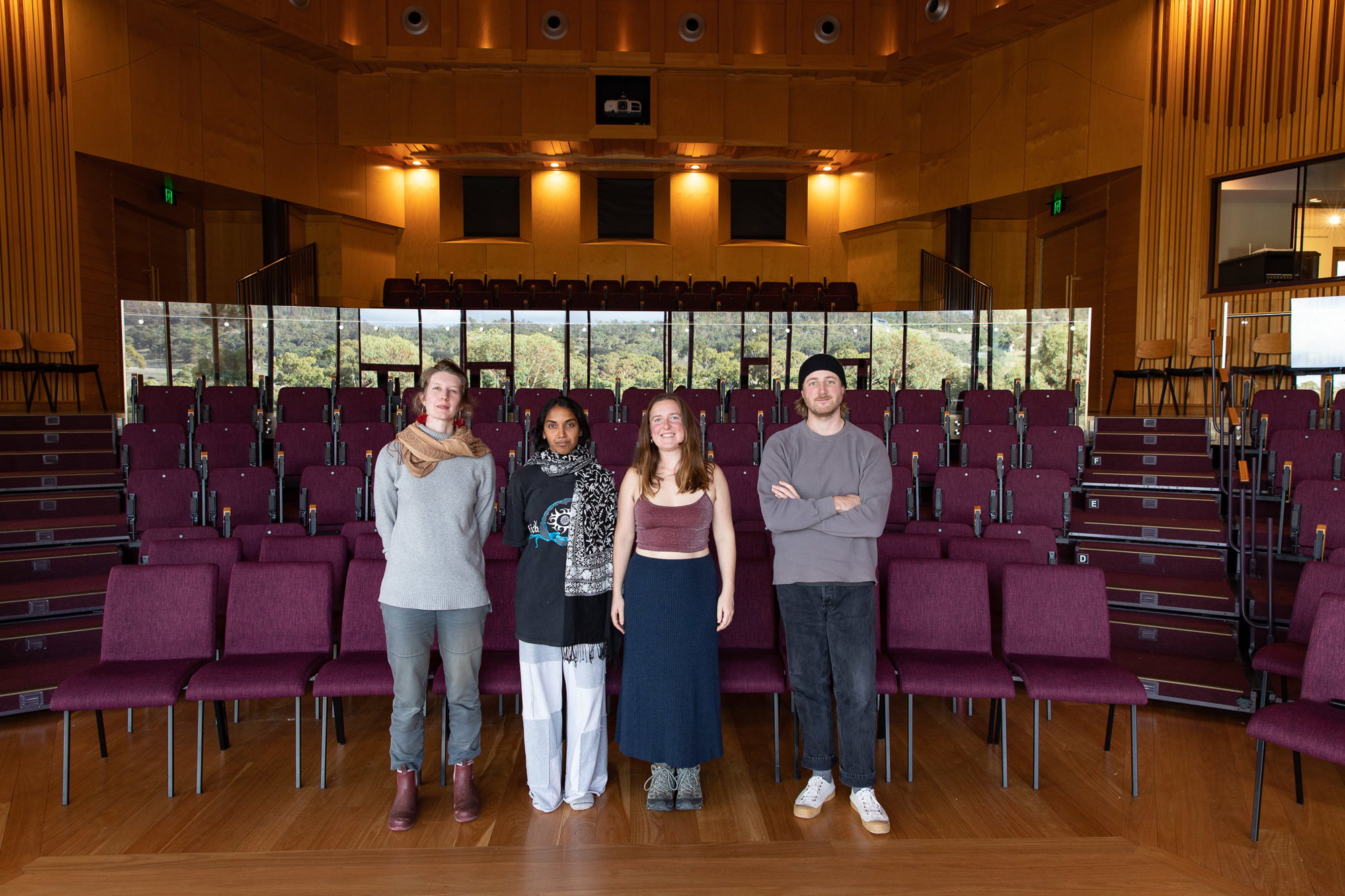
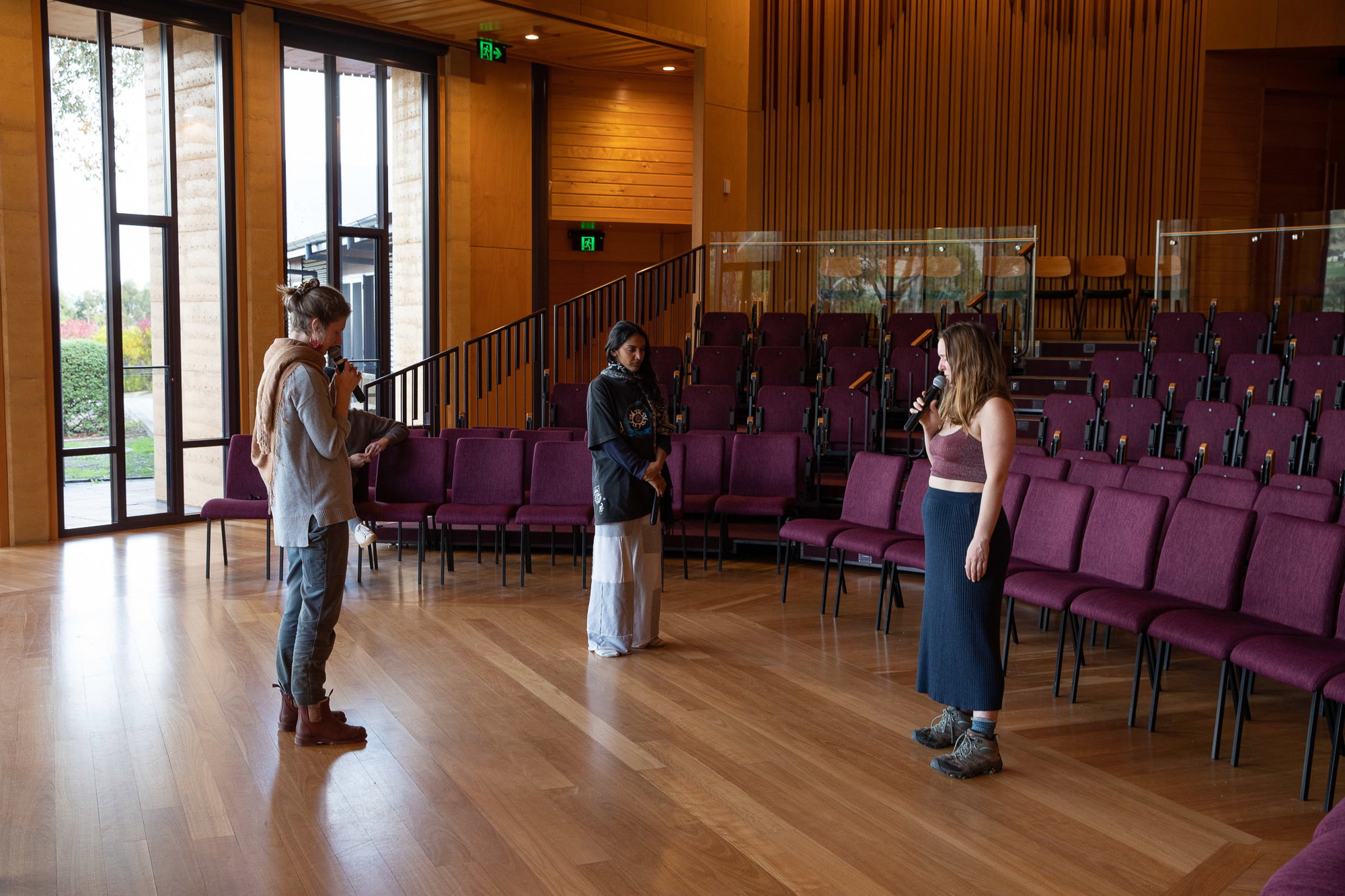
We've been here in the studio at UKARIA for ten days with the vocal ensemble Khyaal [Aarti Jadu, Aurora Darby, Mel Taylor and Siobhan Housden], from Melbourne, and we’ve been working to transcribe these raw- and manipulated-field-recording compositions to the voice – so creating a response to the glacial landscape with just the human voice.
How important has it been for you to have these ten days of uninterrupted time, in this space, to work on your art?
Having the opportunity to just focus on one new task each day within the same project has been so incredibly important. We’ve achieved a level of focus we never could have if we were meeting up in the same city that we’re living in. Just having the opportunity to be disconnected and really focus in on what we’re trying to do, and really creating the parameters within which the work can exist, and letting our imaginations run wild as well… it’s been so fundamental to the creative part of this project.
What are your plans for the work post-residency? Do you hope to program the piece in an upcoming festival, or perhaps produce a recording?
After these ten days are over, I’ll take the recordings that we’ve all done together, and we’ll work them in to the original compositions that I’ve created from the field recordings, to create a seamless transition from raw sound to more composed, vocal-arrangement composition. The future idea is to release the work, and then we’ll start to look at performance possibilities, with the vocal ensemble and myself performing live. The intention is to create a live performance. A lot of the work that the vocal ensemble has done over the past ten days – and a lot of the work that I do – is improvisation-based. So really what we’ve been doing is creating parameters within which we can improvise, and therein lies the possibility of a live, improvisational performance which can modulate and change every time, just as the glacial environment does.
Beyond this work and the residency, what’s next for you as an artist?
I tour a lot with contemporary dance companies, working with choreographers both in Australia and in Europe, and so I will be creating new works and touring them for the foreseeable future. In terms of my own practice, beyond this project (beyond Relativity), I’m starting research on a new project called Anthropogenic, which utilises these same practices but focuses primarily on the Australian landscape.
This residency is supported by a partnership between UKARIA Cultural Centre and the Australia Council for the Arts.